- General operating instructions for wristwatches
- About the warranty
- Wristwatch Brand Rankings
- The 49 Largest Wristwatch Brands
- Summary Table of Wristwatch Brand Values
General Operating Instructions for Wristwatches
- Please use your watch in accordance with the Warranty Terms and the Operating Manual.
- A watch is a precise measuring instrument with delicate mechanism that requires careful handling. It is not recommended to wear a watch during active sports, except for specialized models designed for such conditions.
- Protect the watch from strong impacts, vibration and shocks (for example, when riding a scooter, bicycle, or while using a drill, etc.). In such situations, use special models intended for extreme operating conditions.
- Do not jump from diving platforms, ride jet skis or water attractions while wearing a watch. Avoid hydraulic shocks, overheating (sauna, steam bath, beach), and sudden temperature changes. Special models are designed for such conditions.
- Avoid exposure to strong magnetic and electrical fields (such as powerful speakers, microwave ovens, refrigerators, metal detector gates, industrial metallurgical equipment, etc.).
- Avoid contact with solvents, detergents, perfumes or cosmetic products. These substances may damage the coating of the case or bracelet and compromise the gaskets that maintain the watch’s water-resistant properties.
- To avoid damage or deformation of leather straps, do not allow them to get wet.
- When wearing the watch, always make sure the crown is fully pushed in (closed). Do not press buttons and do not pull the crown out under water, in rain, shower, bath, pool, etc.
- For mechanical watches, quick date correction is prohibited between 8 PM and 4 AM. If the hands are within this zone, first move them to the lower half of the dial. After that you may use quick date correction and then set the exact time.
Water Resistance
The water resistance mark on the case or dial refers to the pressure used during testing and is NOT the allowed diving depth.
1 ATM = 10 meters. The pressure marked in atmospheres should NOT be treated as the actual depth to which the watch can be submerged.
To maintain water resistance, the crown and pushers must be fully closed. Do not press pushers or open the crown underwater, in rain, in the shower, bath, pool, or while washing hands, etc.
Markings on the case:
- 3 АТМ (30 m) – splash & rain resistance;
- 5 АТМ (50 m) – hand washing allowed;
- 10 АТМ (100 m) – showering, bathing, swimming & snorkeling without a mask allowed;
- 20 АТМ (200 m) and more – scuba diving allowed.
Jumping from diving platforms, using jet skis and water attractions is prohibited. Avoid sauna and beach overheating.
If you plan to swim while wearing a 10 ATM+ watch and the warranty period has expired, we recommend checking the water resistance at a service center at least once a year. Seals may lose elasticity over time and require replacement. Regular checks guarantee protection against water penetration.
About the Warranty
For warranty and service inquiries regarding watches of the following brands:
Appella, Beverly Hills Polo Club, Bomberg, Candino, Cover, Festina, Jaguar, Lee Cooper, Lotus, Lucien Rochat, Swiss Alpine Military, Swiss Military by Chrono
covered by a Rougemont warranty card, please contact:
In Armenia
Rougemont LLC
1 Voskerichneri St., Office 97
Meridian Exhibition Center, Yerevan
Phone: +374 94 514-514 (WhatsApp / Viber / Telegram)
Website: https://www.rougemont.am/en/contacts/
E-mail: info@rougemont.am
In Russia
ProTime Service LLC
4 Vetkina St., Floor 3, Business Center “Estet”, Moscow
Phone: 8 (800) 707-65-50
Telegram / MAX: +7 968 632-25-02
Website: https://pro-time.ru/service/
E-mail: service@pro-time.ru
Please note: a valid ID document is required to enter the business center
Appella, Beverly Hills Polo Club, Bomberg, Candino, Cover, Festina, Jaguar, Lee Cooper, Lotus, Lucien Rochat, Swiss Alpine Military, Swiss Military by Chrono









These Warranty Terms and Conditions (hereinafter referred to as the “Warranty Terms” or the “Terms”) define the scope of claims that may be submitted by the consumer to the Seller in the event of a product defect, the procedure and time limits for resolving such claims, as well as the Seller’s liability.
These Terms and the Warranty Rules supplement and clarify the procedure for exercising the consumer’s rights with respect to purchased products.
Failure by the consumer to comply with the operating conditions and instructions for the product (watch) specified herein shall result in the loss of warranty coverage and the Seller’s warranty obligations.
The warranty period for a new product is 24 months from the date of purchase
ROUGEMONT Watch Store (“ROUGEMONT” or the “Seller”) warrants to the consumer that the product will function properly and be free from defects for a period of two years from the date of purchase (one year in the case of pre-owned products), provided that all operating requirements set out in the Operating Instructions, General Conditions of Use and Warranty Certificate are fully complied with, and that the product is used solely for personal purposes not related to professional or business activities and strictly for its intended purpose.
If, during the warranty period and under normal use of the product, a manufacturing defect is discovered, such defect will be repaired free of charge, provided that the product, a duly completed Warranty Certificate, and proof of purchase are presented to an authorized service center designated by the Seller.
If there is no authorized service center designated by the Seller in the region where the product was purchased, the product may be returned to the store where it was purchased for subsequent delivery to an authorized service center.
Opening the product or attempting to repair it for any reason outside an authorized service center shall void the warranty.
Throughout the warranty period, the watch shall be serviced exclusively by an authorized service center.
The Warranty Certificate is valid only for the product for which it was issued. A Warranty Certificate containing blank or illegibly completed fields relating to the product description, any alterations, or lacking the required signatures shall be deemed invalid.
The Warranty Certificate must be completed legibly and contain the following information: the brand, reference number (item number), serial number (if applicable), date of sale, the store’s stamp (seal), and the signatures of authorized persons.
The following shall be permitted during the warranty period and shall not be considered defects:
- discharge of the battery originally installed by the manufacturer. During the warranty period, battery replacement must be carried out exclusively by an authorized service center. The customer shall pay only for the replacement battery, while the replacement service shall be provided free of charge by the authorized service center;
- normal wear and tear of the strap, bracelet, case, push-buttons, and crown of the watch, as well as wear of their surface coating (including gold plating, metal plating, or similar finishes) resulting from normal use;
- misalignment between the hour and minute hands of less than half a minute graduation when aligned at the 12:00 position;
- deviation of the seconds hand from the scale markers by less than half a second graduation;
- backlash of the hour and minute hands in quartz watches not exceeding half a second graduation;
- a daily rate deviation of mechanical watches within −20/+40 seconds per day, and a monthly rate deviation of quartz watches within ±20 seconds per month. The accuracy specification applicable to your watch is provided in the Operating Instructions;
- deviation of the alarm activation time from the set time not exceeding ±6 minutes;
- deviations of the product’s technical characteristics from the permissible limits specified in the technical documentation, provided that such deviations can be corrected by adjustment and calibration at an authorized service center without replacement of any parts.
The warranty does not apply to products showing any of the following signs of improper use:
- signs of impact or mechanical damage, including dents, nicks, dislodged hands, hour markers/indices or numerals, a missing or deformed crown, and other similar damage;
- signs of unauthorized opening or disassembly outside an authorized service center, including scratches on the case at the case back joint, damaged screw slots, fingerprints inside the movement, a non-original battery, an incorrectly fitted case back gasket, or similar evidence of unauthorized servicing;
- signs of exposure to high temperatures (above +50°C) or low temperatures (below −20°C);
Internal or external damage caused by any external mechanical impact, shock, vibration, or the application of excessive force to any part of the product, including cracked, broken or dislodged crystal, cracks, scratches, gouges, chips, deformation of materials or components, a broken or bent crown stem, bent wheel or balance staff pivots, deformed plates, broken or stretched components, detached case lugs for bracelet or strap attachment, and similar damage.
Damage to the watch caused by water ingress resulting from failure to comply with the operating instructions. Watches marked “Water Resistant 30 m” or “Water Resistant 50 m” are not intended for swimming. The crown and push-buttons must not be operated while the watch is in water, except in the case of specialized scuba-diving watches bearing the “DIVER” marking on the case back.
Damage caused by contact of the watch case or strap with corrosive chemicalsor gases, including alkalis, acids, paint, gasoline, mercury, plastic solvents, their vapors, or other similar substances.
Damage resulting from the ingress of foreign objects, substances, or insects into the product.
Damage to the calendar mechanism caused by the customer adjusting the watch hands between 11:00 p.m. and 4:00 a.m., while the automatic date and day-of-the-week change mechanism is engaged;
Any other damage caused by intentional or negligent acts or omissions of the purchaser, or by failure to comply with the operating instructions.
If the product or watch has a manufacturing defect that was not caused by a failure to follow the operating instructions, or if it does not comply with the contract or applicable law, the consumer has the right to submit a written claim and request any remedy provided by law, including free repair, replacement, a proportionate price reduction, termination of the contract, or any other legal remedy.
A claim must be submitted no later than two months from the date the defect or non-conformity was discovered, unless a longer period is provided by law. The claim must be made in writing and submitted together with the defective product to the store where it was purchased or to an authorized service center designated by the Seller. It may also be sent by registered mail. ROUGEMONT may require the consumer to provide the product or watch for inspection, diagnosis, testing, or repair, provided that such a request is reasonable and does not restrict the consumer’s rights under applicable law.
For the Seller to consider the claim, the consumer must include the necessary information and attach the following documents and materials:
- the consumer’s first name, last name, and contact details;
- proof of purchase;
- the Warranty Certificate issued by ROUGEMONT, containing the brand (trademark), reference number (item number), serial number (if applicable), date of sale, the store’s stamp (seal), and the signatures of the authorized persons;
- the name of the product or watch, the model, the reference number, or any other identifying information;
- the product or watch in its current condition and with all available components and accessories, for the purposes of inspection, diagnosis, or examination;
- the date on which the defect was discovered, the circumstances in which it was identified, and a detailed description of the defect or non-conformity;
- if available, photographs, video recordings, or any other evidence of the defect or non-conformity;
- the consumer’s claim submitted in accordance with the Law of the Republic of Armenia “On Consumer Rights Protection” and other applicable legal acts.
Unless otherwise provided by the applicable legislation, a claim submitted by the consumer in accordance with the legislation of the Republic of Armenia and these Terms and Conditions shall be reviewed by ROUGEMONT, and the relevant defects shall be remedied, where possible, within twenty (20) days from the date of receipt of the claim.
If remedying the defects in the product requires additional information from the consumer or the manufacturer, or if the defects cannot be remedied, the period for reviewing the claim and the period for remedying the defects may be extended for a reasonable period determined by the Seller, but in no event exceeding one hundred and eighty (180) days.
The Seller may, at its discretion, decide either to repair the product or to replace it with a new product of the same or an equivalent model.
If the claim is not properly submitted and/or does not contain the information required under this procedure, ROUGEMONT reserves the right to refuse warranty service for the product or watch.
The consumer understands and unconditionally accepts that, in all cases involving material non-conformities relating to the product or watch, as defined in the Law of the Republic of Armenia “On Consumer Rights Protection,” any such claims must be submitted directly to the manufacturer in accordance with Part 6 of Article 17 of the Law of the Republic of Armenia “On Consumer Rights Protection.” In such cases, ROUGEMONT shall not be liable for remedying any material non-conformity in the product and/or for reviewing any claims submitted in connection with the remedy thereof.
The warranty does not cover:
- batteries;
- wear, abrasion, and scratches to straps, bracelets, and product or watch cases arising during normal use of the product;
- damage resulting from normal wear and tear, accidents, improper use, or any unauthorized modification of the product;
- malfunctions or changes in the appearance of the product caused by natural phenomena, including rust, moisture, and similar environmental factors;
- damage or defects resulting from impact, dropping, or other mechanical force applied to the product;
- damage resulting from unauthorized repair or servicing performed by a service center not authorized by the Seller;
- damage caused by failure to follow the product operating instructions;
The warranty does not cover,
and the Seller shall have no obligation or liability to remedy any defects resulting from water ingress caused by failure to comply with the water resistance requirements specified by the manufacturer.
If the watch is water-resistant, it shall function properly only under the conditions specified by the manufacturer. The water resistance of the watch does not mean that it is completely immune to water exposure. Damage caused by water ingress shall not be covered by the warranty if it results from the consumer’s failure to follow the manufacturer’s instructions.
The terms and conditions of this Warranty may not be amended by any person or entity, except where such amendment is made by ROUGEMONT.
Important Notice:
If the original proof of purchase is not provided with the product, or if the defect or malfunction of the product is determined not to be covered by this Warranty, all repair services shall be performed on a paid basis.
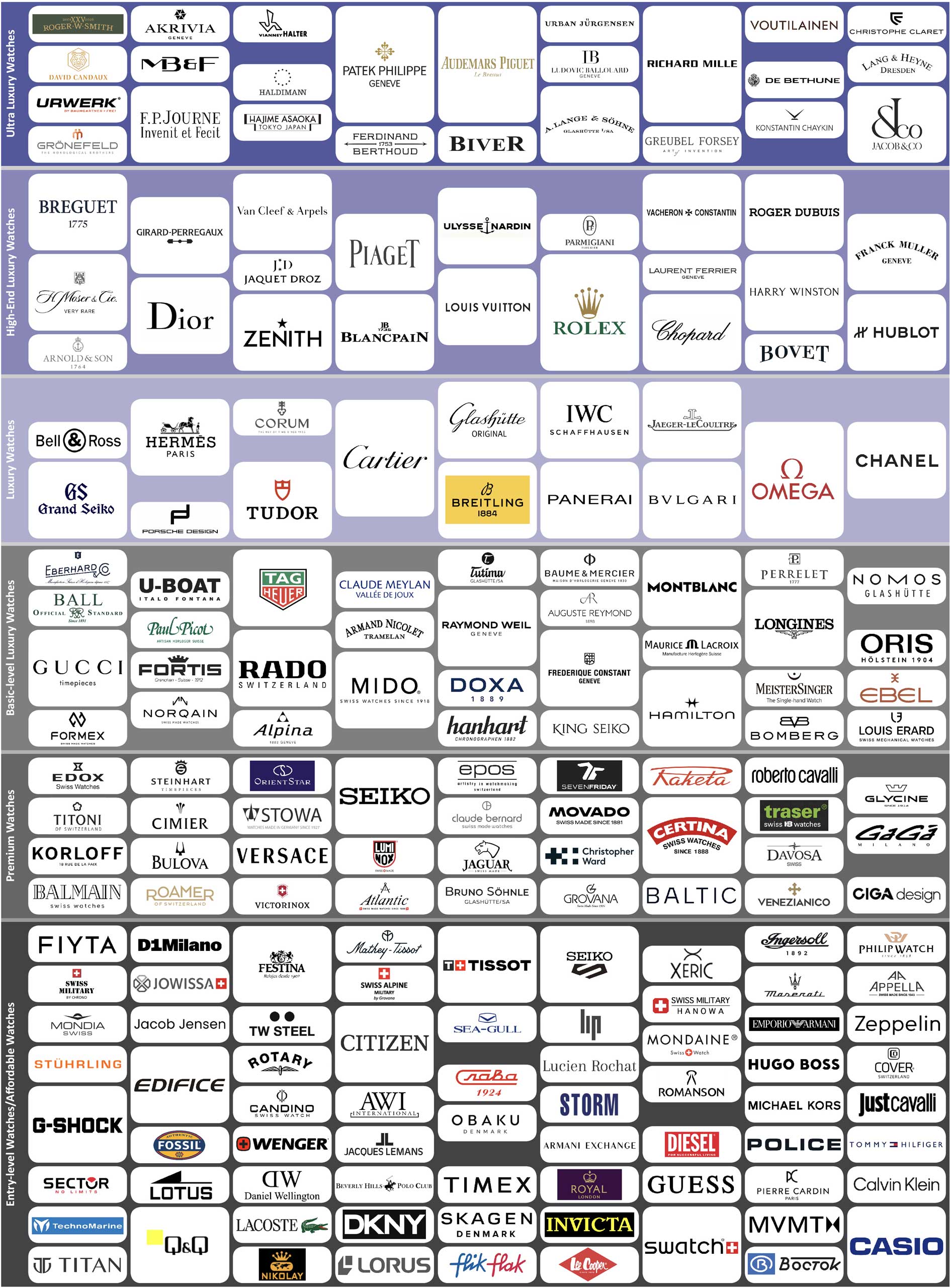
Wristwatch Brand Rankings
How do you know how prestigious a particular brand’s watch is? Ratings provide the answer.
The world of watches is diverse, and many factors – often difficult to compare – shape the perception of each watch. For example, a certain brand may offer very expensive watches but be little known to the public. Can this brand’s watch be considered more prestigious than another brand’s watch that is positioned lower price-wise but is widely recognized and highly regarded? Or consider another situation: one brand operates in the jewelry watch segment, while another offers primarily complex mechanical models, and their basic price ranges are roughly the same. Which of these two brands will be positioned higher?
There are no precise answers to such questions; it’s largely a matter of personal preference. Because of this, it’s impossible to create a single rating that clearly shows which watches are positioned higher and which are positioned lower. To better understand the landscape, it’s worth looking at different ratings that take various aspects into account, so that a connoisseur of fine watches can focus on those that highlight the aspects most important to him or her.
We suggest beginning our study of watch ratings with the most obvious and easily understood parameter: the typical retail price range for a given brand. It’s natural to associate this parameter with the concept of “luxury.” Indeed, it seems perfectly normal for exceptional watches to cost significantly more than merely good ones, which in turn are more expensive than simple watches aimed at the mass market.
When compiling our ratings, we analyzed collections from reputable, respected brands that don’t produce copies of other brands’ watches, but instead develop their own collections and mark them with their own logos.
We analyzed collections from various brands representing the most important players in the market to determine their typical retail price ranges for new watches, which allowed us to rank these brands according to the following scale:
- Entry-Level / Affordable Watches: under $500
- Subsegment of Budget-Friendly Watches: under $150
- Subsegment of Mass-Market Watches: $150 to $300
- Subsegment of Mid-Range Watches: $300 to $500
- Entry-Level Luxury / Premium Watches: $500 to $1,500
- Basic Luxury Watches: $1,500 to $5,000
- Luxury Watches: $5,000 to $15,000
- High-End Luxury Watches: $15,000 to $50,000
- Ultra-Luxury Watches: $50,000 and up
In principle, it would be entirely possible to choose the Swiss franc or the euro as the base currency for analytical purposes; however, at present, the differences between the franc, euro, and dollar alter the overall picture only insignificantly, especially considering that it makes more sense to compare watches from different brands than to look at their position in a particular category.
Entry-Level / Affordable Watches Segment: under $500
Let’s begin our analysis with the most affordable watches, which typically cost under $500. What characterizes such watches? To survive in this market segment, brands are forced to produce watches in large quantities (mass production) and, as a result, try to save as much as possible on components, primarily using parts made in Eastern countries. Moreover, these watches – along with their packaging and documentation – are entirely manufactured in Eastern countries, mainly China and Hong Kong. Most of them look quite striking at first glance, but that impression changes when you examine them closely, especially under a magnifying glass.
Watches in this category are often casual, sporty, or urban in style. They tend to be relatively large (40 mm or more), have a polished finish, incorporate gold-plated or other metal-plated components, and are offered on bracelets. The affordable watch segment also includes a significant number of everyday dress models with a dressy look and minimal functionality, most often with just two hands. Many manufacturers produce watches under license, using the brand name of a designer fashion label. It is common practice to use designs that resemble popular models from higher market segments, often to the point of confusion. Women’s watches may be offered with rhinestone encrustments.
Watches in this segment are mostly equipped with basic, affordable quartz movements from Miyota or SII/Epson/TMI. These movements offer typical quartz accuracy, with a deviation of about 15 seconds per month. Only occasionally are watches in this segment fitted with automatic movements from Eastern manufacturers. Maintenance is generally not expected, apart from battery, strap, or bracelet replacement.
This segment is highly competitive, as is the entire watch market, and the diversity is vast, especially because the collections of brands operating here are updated at a very rapid pace.
Since this segment is home to a significant number of watch brands, it makes sense to divide it into three subsegments:
Subsegment of Budget-Friendly Watches: under $150
Watches in this category are generally characterized by a low price and basic functionality (two or three hands, digital LCD display).
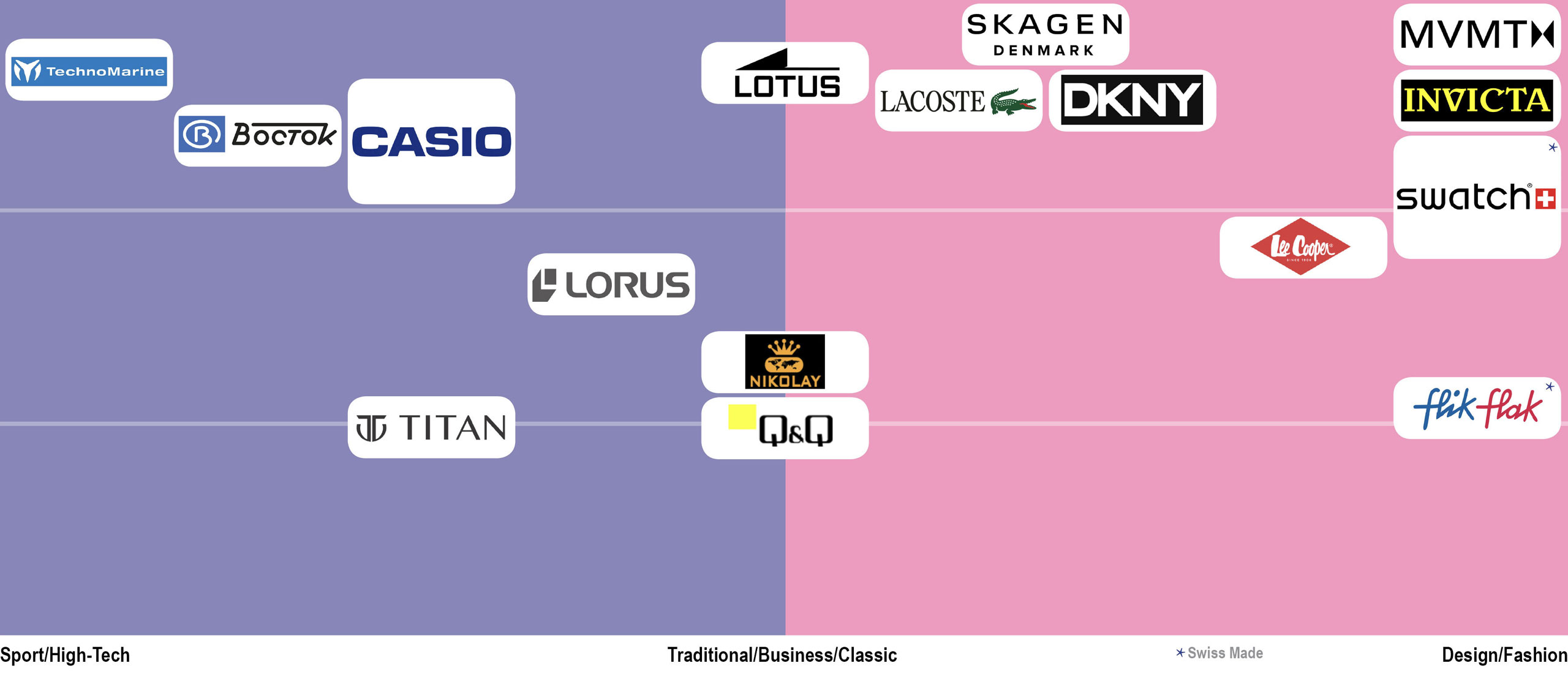
The most well-known brands in the Entry-Level / Affordable Watches segment, in the Budget-Friendly Watches subsegment, are:
- Casio
- Flik Flak
- Invicta
- Lacoste
- Lee Cooper
- Lorus
- Lotus
- Mvmt
- Nikolay
- Q&Q
- Skagen
- Swatch
- TechnoMarine
- Titan
- Vostok
Sporty or fashion-styled? Positioning brands in the affordable watch segment, specifically in the budget-friendly subsegment (under $150).
Subsegment of Mass-Market Watches: $150 to $300
This subsegment offers an optimal price-quality ratio, with products manufactured in large quantities and aimed at most buyers.
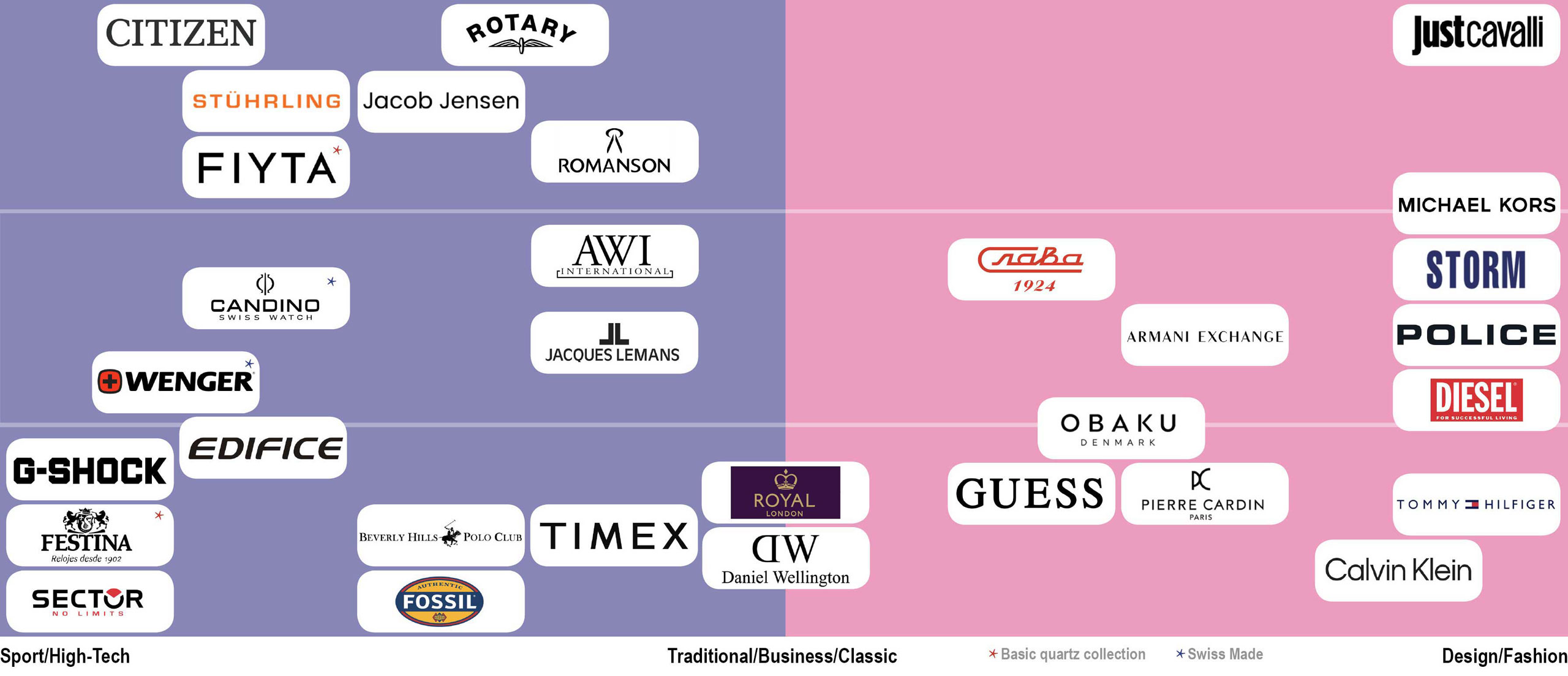
The most well-known brands in the Entry-Level / Affordable Watches segment, in the Mass-Market Watches subsegment, are:
- Armani Exchange
- AWI (Armenian Watch International)
- Beverly Hills Polo Club
- Citizen
- Calvin Klein
- Candino
- Casio Edifice
- Casio G-Shock
- Daniel Wellington
- Davosa (models with quartz movement)
- Diesel
- DKNY
- Emporio Armani
- Festina
- Fiyta
- Fossil
- Guess
- Jacob Jensen
- Jacques Lemans
- Just Cavalli
- Michael Kors
- Obaku
- Pierre Cardin
- Police
- Romanson
- Rotary
- Royal London
- Sector
- Slava
- Storm London
- Stührling
- Timex
- Tommy Hilfiger
- Wenger
Sporty or fashion-styled? Positioning brands in the affordable watch segment, specifically in the mass-market subsegment ($150 to $300).
Subsegment of Mid-Range Watches: $300 to $500
Watches in this category feature higher quality than those in the previous subsegment, use better materials, and are generally repairable.
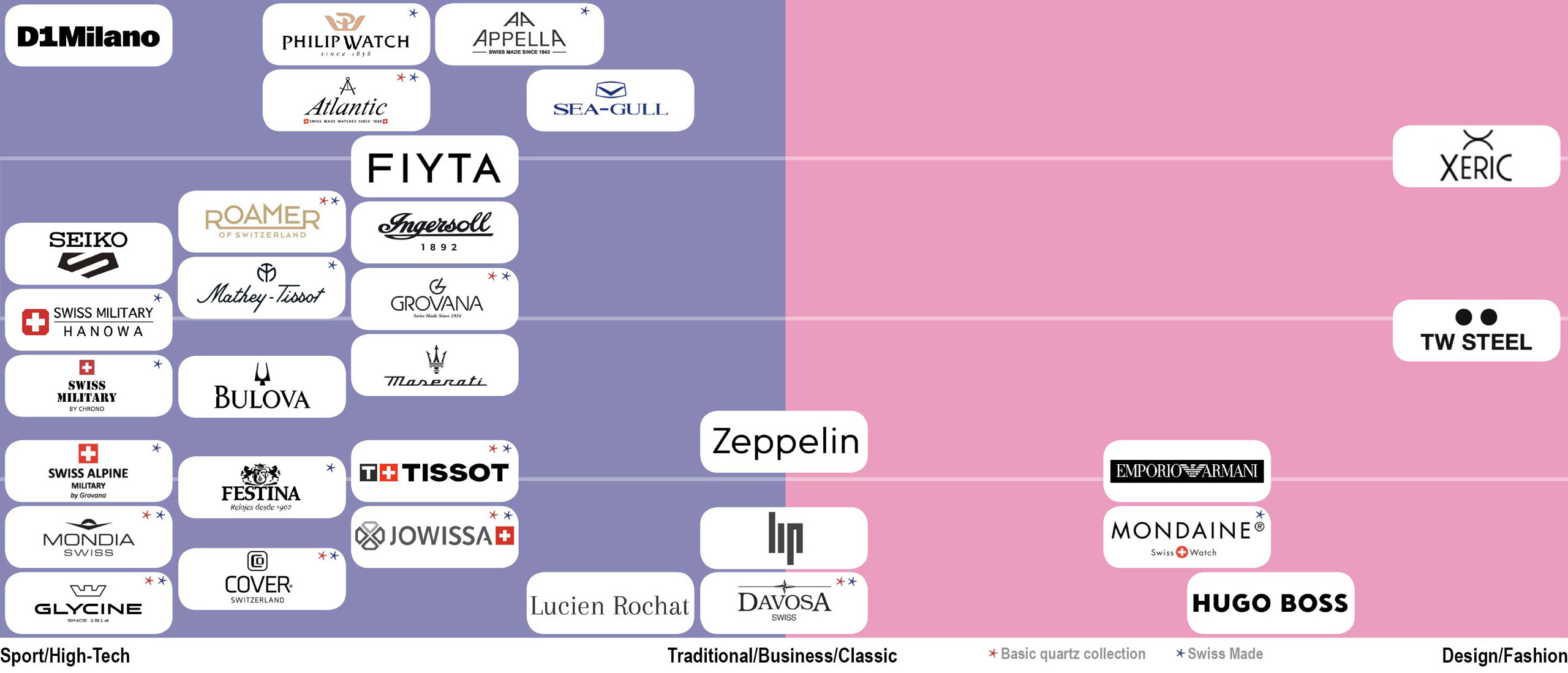
The most well-known brands in the Entry-Level / Affordable Watches segment, in the Mid-Range Watches subsegment, are:
- Appella
- Atlantic (models with quartz movement)
- Bulova
- Cover
- D1 Milano
- Festina (models with quartz movement; Swiss-made)
- Fiyta
- Glycine (models with quartz movement)
- Grovana
- Hugo Boss
- Ingersoll
- Jowissa
- Lip
- Lucien Rochat
- Maserati
- Mathey-Tissot
- Mondaine
- Mondia
- Philip Watch
- Roamer (models with quartz movement)
- Seiko 5 Sports
- Sea-Gull
- Swiss Alpine Military by Grovana
- Swiss Military by Chrono
- Swiss Military by Hanowa
- Tissot (models with quartz movement)
- TW Steel
- Xeric
- Zeppelin
Sporty or fashion-styled? Positioning brands in the affordable watch segment, specifically in the mid-range subsegment ($300 to $500).
Entry-Level Luxury / Premium Watches: $500 to $1,500
Watches in this category are defined by higher-quality execution than those in the affordable category. Manufacturers strive to avoid compromises in features, which typically means exceeding a basic level of quality even in aspects that are functionally irrelevant. This includes using a Swiss or Japanese movement (Eta/Sellita/Miyota), often an automatic movement in a basic configuration (“two-hand,” “three-hand with date”), or a quartz movement with additional functions such as a chronograph, along with a well-finished dial and hands.
To reduce costs, watches are still produced in large quantities. Compared to affordable watches, more attention is paid to the final finishing, which exceeds the basic industrial level and is usually clearly visible when handling the watch. Watch brands place greater emphasis on historical continuity in the development of collections, signature designs, and the brand’s image as a traditional watchmaker with an interesting and important history. Watches in this category are typically repairable and designed for long-term use.
The most well-known brands in the Entry-Level Luxury / Premium Watches segment, are:
- Atlantic (models with automatic movement)
- Balmain
- Baltic
- Bruno Söhnle
- Bulova (premium collections Precisionist, Jet Star, Lunar Pilot, Wilton, Series X, Oceanographer GMT, CURV)
- Certina
- Christopher Ward
- Ciga Design
- Cimier
- Claude Bernard
- Davosa (models with automatic movement)
- Edox
- Epos
- Festina (premium collections Connected and Swiss Made; models with automatic movement)
- Frédérique Constant (basic models)
- GaGa Milano
- Glycine (models with automatic movement)
- Grovana (models with automatic movement)
- Jaguar
- Korloff
- Luminox
- Maurice Lacroix (models with quartz movement)
- Michel Herbelin
- Movado
- Orient Star
- Raketa
- Roamer (models with automatic movement)
- Roberto Cavalli
- Seiko (premium collections Presage, Prospex, Speedtimer Solar, Alpinist, GMT)
- Sevenfriday
- Steinhart
- Stowa
- Tissot (models with automatic movement; premium collections)
- Titoni
- Traser
- Versace
- Venezianico
- Victorinox
Basic Luxury Watches: $1,500 to $5,000
Watches in this category are defined by a strong historical influence: brands often lean on themes of heritage, notable historical events, and connections to watchmaking traditions in both their communications and their collection design. These watches typically feature classic dress or vintage-inspired designs, and their collections include a high proportion of mechanical and automatic models with complications, primarily time zone indicators, power reserve indicators, moonphase displays, world time, simple calendar functions, and chronographs. Manufacturers deliver a higher level of craftsmanship than in the premium watch segment. This includes the use of prestigious case materials such as stainless steel, titanium, high-tech ceramic, and bronze. Brands can afford to equip their watches with customized calibers, manufactured by suppliers according to each brand’s specifications and designs.
Collections also feature models with exclusive movements (in-house designed, assembled, or fully in-house produced), but generally without complications. High-quality industrial finishing can be complemented by decorative techniques applied to both exterior components (case, bracelet, clasp, dial, hands) and movement components. Watches are often fitted with high-quality bracelets or straps featuring a signature design. Mechanical watches frequently have a transparent caseback, allowing the decorated movement to be viewed. Watches are produced in large series – hundreds or thousands of pieces – and are designed for long-term use, subject to technical maintenance and repair. One of the incentives for purchasing watches in this category is their collectible appeal.
The most well-known brands in the Basic Luxury Watches segment, are:
- Alpina
- Armand Nicolet
- Auguste Reymond
- Ball
- Baume and Mercier
- Bomberg
- Claude Meylan
- Doxa
- Ebel
- Eberhard & Co.
- Formex
- Fortis
- Frédérique Constant
- Gucci
- Hamilton
- Hanhart
- King Seiko
- Longines
- Louis Erard
- Maurice Lacroix (models with mechanical movement)
- MeisterSinger
- Mido
- Montblanc
- Nomos Glashütte
- Norqain
- Oris
- Paul Picot
- Perrelet
- Rado
- Raymond Weil
- TAG Heuer
- Tutima Glashütte
- U-Boat
Luxury Watches: $5,000 to $15,000
This category is dominated by popular Swiss watch brands, many of which have histories spanning a century or more, full of interesting events and remarkable achievements. This has fueled the growth of enthusiastic communities that create a special aura around these brands by collecting and studying their watches. Often, the most popular luxury models enjoy a level of perceived value, recognition, and prestige comparable to the brand itself. Such models include the Santos and Tank by Cartier, the Navitimer by Breitling, the Speedmaster Professional by Omega, the Pilot’s Watch by IWC Schaffhausen, the Reverso by Jaeger-LeCoultre, and the Radiomir and Luminor by Panerai, to name just a few. Overall, signature designs and the collections built around them play a central role in a brand’s business.
Compared with Basic Luxury Watches segment, watches of Luxury Watches segment are typically distinguished by extensive use of in-house mechanical calibers (that is, movements of their own production and design) with automatic or manual winding, a higher level of decorative finishing, and significant technical innovations such as silicon technology, advanced escapements, and antimagnetic protection. Strict quality standards are applied at every stage of production, ensuring highly precise movements and top-quality components, including the case, dial, bracelet or strap, and clasp. A significant proportion of luxury brand collections are crafted from precious metals. Watches in this category, especially the most popular and historically important designs, have strong potential for value retention and long-term collector appeal.
The most well-known brands in the Luxury Watches segment, are:
- Bell & Ross
- Breitling
- Bulgari
- Cartier
- Chanel
- Corum
- Glashütte Original
- Grand Seiko
- Hermès
- IWC Schaffhausen
- Jaeger-LeCoultre
- Officine Panerai
- Omega
- Panerai
- Porsche Design
- Tudor
High-End Luxury Watches: $15,000 to $50,000
Watches in this category highlight the handcrafted work of the watchmaker and decorative finishing specialist. High-luxury watches are valued not only for their technical excellence, the inventions incorporated into the watch, the use of advanced technology, their beautiful appearance, signature design, brand prestige, and historical achievements, but also for the high quality of handcrafted production, finishing, assembly, and adjustment of the movement, exterior components (case, strap or bracelet, clasp), and even presentation elements such as the luxury box. As a result, such watches are perceived as exclusive and significant for watchmaking, both in terms of preserving and advancing its traditions. This exclusivity is reflected in a relatively low or very low annual production volume, which for a brand typically ranges from hundreds to several thousand pieces, rarely up to several tens of thousands, while individual models may be released in limited editions of tens, hundreds, or, more rarely, thousands of pieces.
The primary buyers of watches in this category are wealthy clients – often friends of the brand – as well as collectors and connoisseurs of handcrafted timepieces. In the high-luxury segment, mechanical models predominate, and a significant proportion of these feature complications, starting with small, practical ones such as time zone or world time displays, moonphase, power reserve indicators, various retrograde displays, digital indications, and big dates. The list of complications continues with traditional grand complications, including annual or perpetual calendars, chronographs, split-seconds chronographs, tourbillons, and minute repeaters. The crowning achievement is ultra-complicated models, which combine two or more grand complications, often supplemented by several small complications.
Brands primarily equip their watches with movements developed and manufactured in-house, including both basic calibers and movements with complications. The watches are crafted from premium, exclusive materials such as stainless steel, titanium, and high-tech ceramics, while a significant proportion are made of precious metals or feature gem-encrusted designs. High-luxury watches are often purchased as status symbols and collector’s items, but they are also suitable for everyday wear. These watches are frequently regarded as heirlooms, passed down from generation to generation.
The most well-known brands in the High-End Luxury Watches segment, are:
- Arnold & Son
- Blancpain
- Bovet
- Breguet
- Chopard
- Dior
- Franck Muller
- Girard-Perregaux
- H. Moser & Cie
- Harry Winston
- Hublot
- Jaquet Droz
- Laurent Ferrier
- Louis Vuitton
- Parmigiani Fleurier
- Piaget
- Roger Dubuis
- Rolex
- Ulysse Nardin
- Vacheron Constantin
- Van Cleef & Arpels
- Zenith
Ultra-Luxury Watches: $50,000 and up
At this level, the focus is on the creator – primarily the watchmaker, often an independent one developing their own brand, but also designers and entrepreneurs. Brands do not hide the names of their artisans in their communications, which is typically not the case for brands operating in other market segments. Ultra-luxury watches are no longer seen simply as technical timepieces, but as works of art.
Watches in this category are often marketed as landmark achievements in watchmaking, securing a place of honor in the history of the craft. While key factors such as precision, functionality, reliability, and the high quality of the movement and exterior components remain fundamental, their value is significantly enhanced by the predominant use of handcraft, which gives these watches an aura of exclusivity and even museum-worthy status. Ultra-luxury watches are defined by extreme rarity: annual production volumes for such brands typically range from several dozen to hundreds, rarely reaching several thousand, and specific models are often made as limited editions or one-of-a-kind pieces. The primary clientele are collectors, so a significant portion of a watch brand’s output in this category consists of custom-made watches.
The most well-known brands in the Ultra-Luxury Watches segment, are:
- Akrivia (Rexhep Rexhepi)
- A. Lange & Söhne
- Audemars Piguet
- Biver
- Christophe Claret
- David Candaux
- De Bethune
- Ferdinand Berthoud
- F. P. Journe
- Greubel Forsey
- Grönefeld
- Hajime Asaoka
- Haldimann
- Jacob & Co
- Konstantin Chaykin
- Lang & Heyne
- Ludovic Ballouard
- MB&F
- Patek Philippe
- Richard Mille
- R.W. Smith
- Urban Jürgensen
- Urwerk
- Vianney Halter
- Voutilainen
49 of the World’s Largest Watch Brands: Market Positioning in 2025
One of the most reliable indicators of a watch brand’s prestige, demand, and popularity is its annual sales. Unfortunately, not all brands share their financial performance with the public, so experts have to rely on estimates. In the watch industry, one of the most comprehensive summaries of sales figures for primarily Swiss watch brands is published by analysts at the Swiss bank Vontobel.
Here we provide information on annual sales volume, number of watches produced, and average retail price per watch, based on a report from Vontobel Bank covering 49 leading brands with annual sales of 50 million Swiss francs or more as of 2025.
It’s important to note that Vontobel doesn’t report the results of the Japanese brands that hold significant positions in the global watch industry – specifically the Seiko, Citizen, and Casio groups – in its reports. Unfortunately, the financial reports of these corporations don’t provide separate sales figures for individual brands within their groups, and they also include figures for divisions that specialize in watchmaking, producing movements and other components rather than finished watches.
For example, the Seiko Group includes the Watch Division, which offers watches under the Grand Seiko, Credor, King Seiko, Seiko Prospex, Seiko Astron, Seiko Presage, and Seiko 5 Sports brands, as well as Seiko Instruments Inc. (SII), Seiko Epson Corporation, and Time Module Inc. (TMI), which produce movements and components for both their own brands and for third parties. According to the Seiko Group, in the 2025/2026 fiscal year (April 1, 2025 – March 31, 2026), the Watch Division’s total sales were 203 billion yen, or approximately 1.076 billion Swiss francs at the average exchange rate for the period.
Citizen Watch Co., which includes the Citizen and Bulova brands and movement maker Miyota, reported sales of 197 billion yen for the same period, equivalent to 1.044 billion Swiss francs, while Citizen’s Swiss brands Frédérique Constant, Alpina, Angelus, Arnold & Son, and movement maker La Joux-Perret are not included.
Casio’s watch division posted results of 185 billion yen (approximately 980 million Swiss francs) in the 2025/2026 fiscal year.
All of this suggests that Japanese brands could show up in Vontobel’s ranking, most likely in positions ten to twenty.
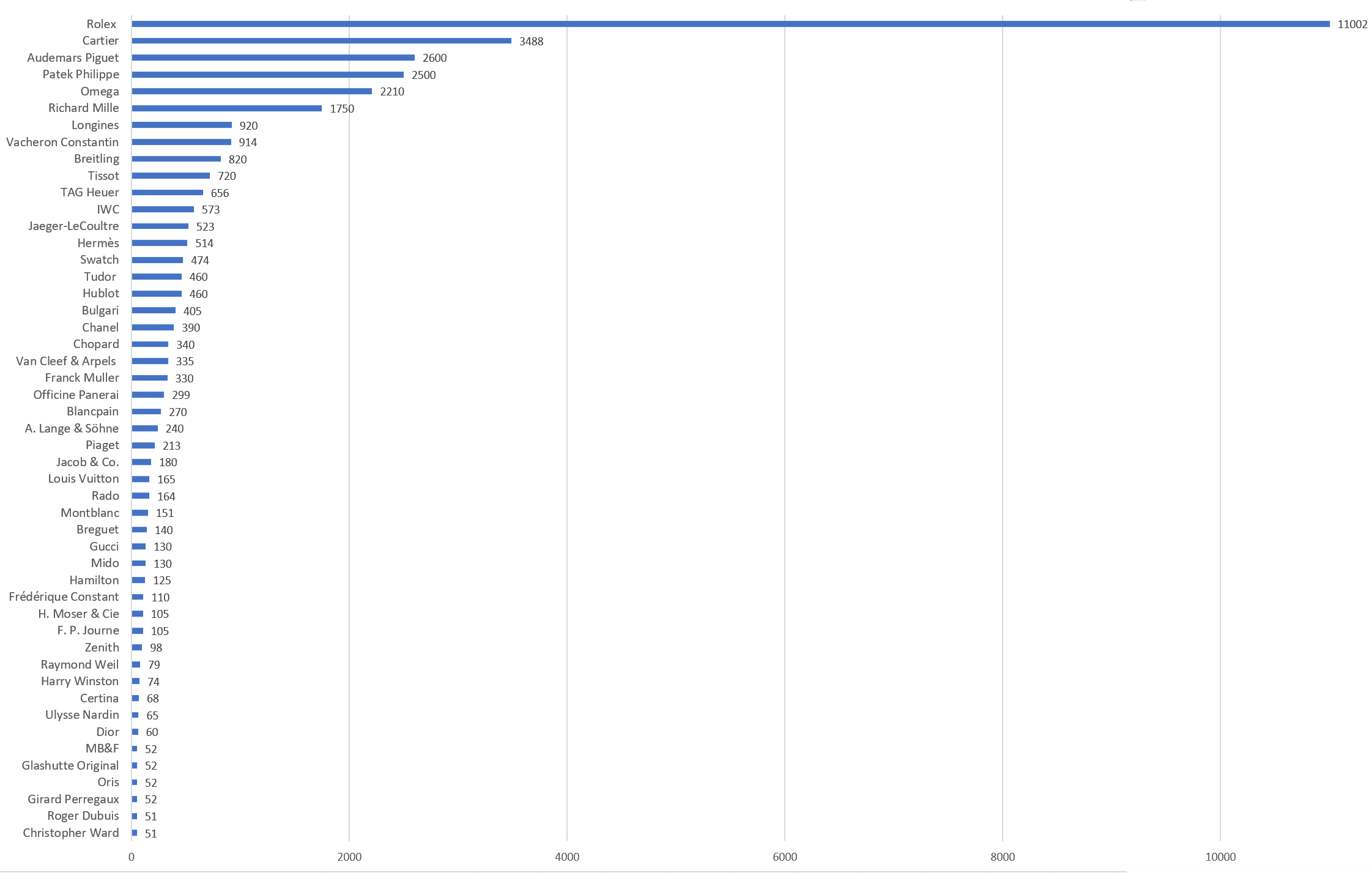
A ranking of the world’s 49 leading watch brands by annual sales as of 2025 (in millions CHF).
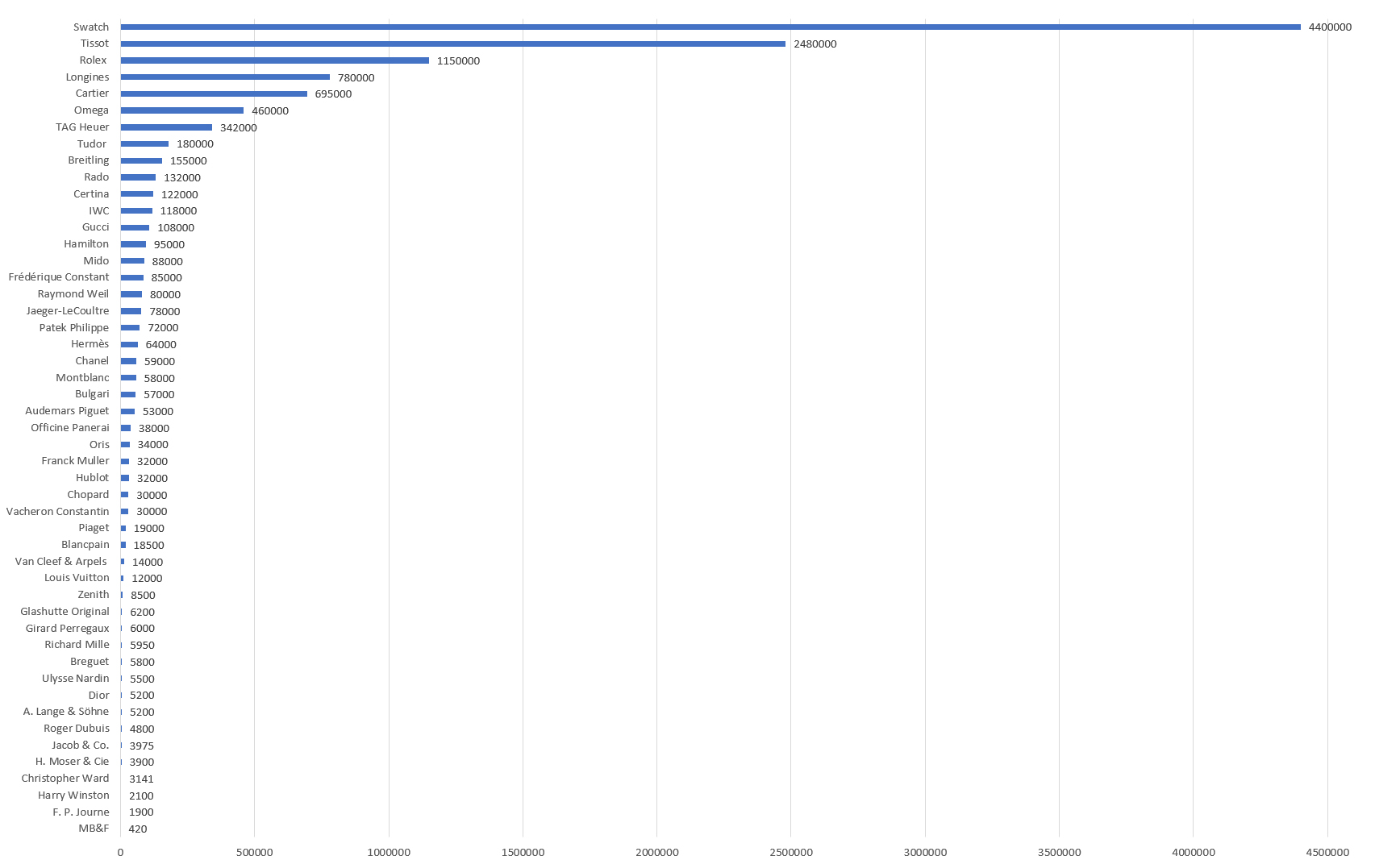
A ranking of the world’s 49 leading watch brands by the number of watches produced annually as of 2025 (in pieces). This ranking shows which brands specialize in mass production, including luxury and high-luxury watches, and which focus on truly exclusive timepieces.
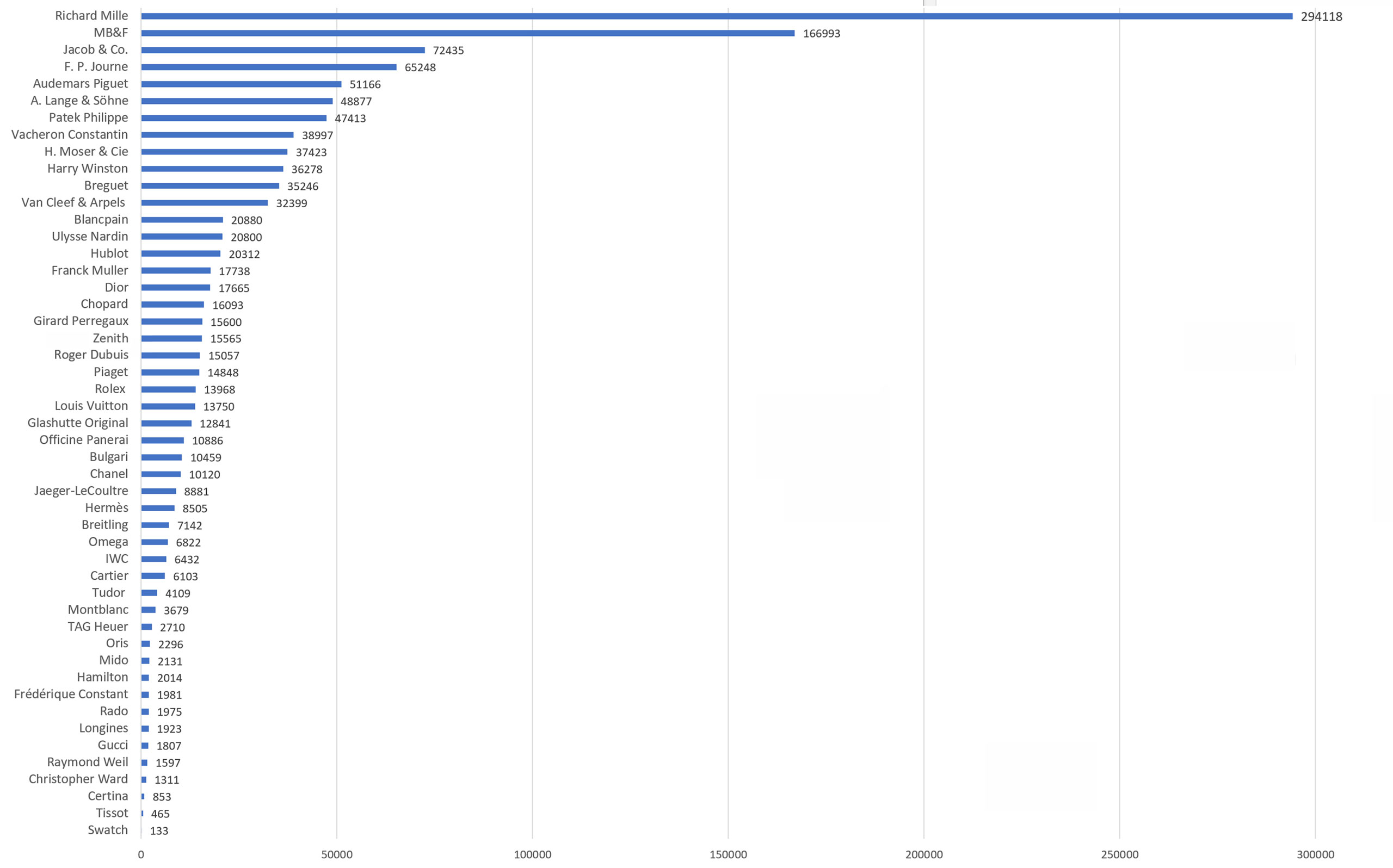
A ranking of the world’s 49 leading watch brands by average retail price as of 2025 (in CHF). This ranking makes it easy to see which market segment each brand operates in.
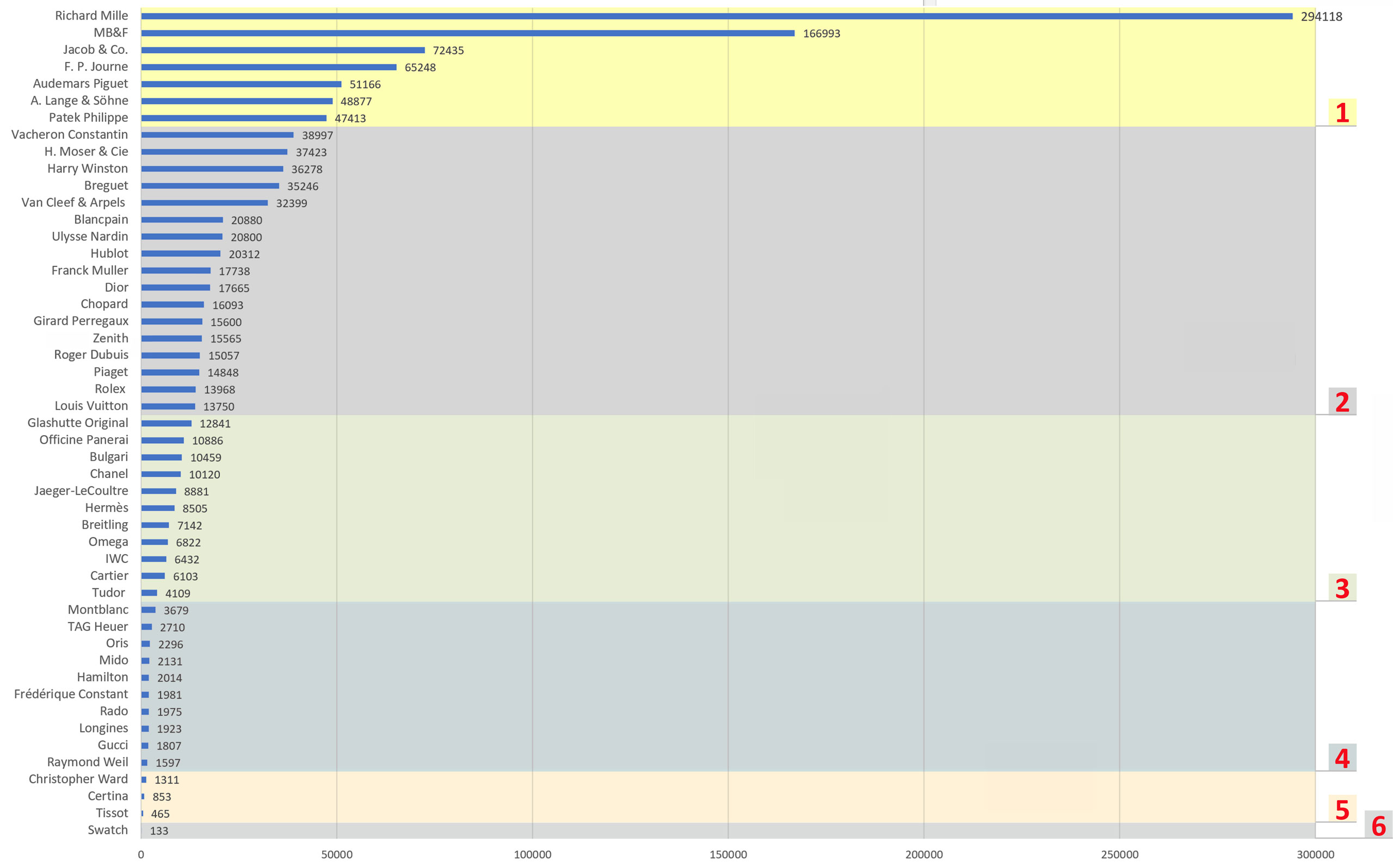
A ranking of the world’s 49 leading watch brands by average retail price in CHF. as of 2025. This illustration complements the ranking with color coding for the main segments of the watch market, showing how strongly brands from different segments are represented in the ranking of key market players.
- Ultra Luxury Watches
- High-End Luxury Watches
- Luxury Watches
- Basic-level Luxury Watches
- Premium Watches
- Affordable Watches
Summary Table of Wristwatch Brand Values